
Cloud technologies can be broadly categorized into two groups: Deployment models and Service models.
Deployment models define where the cloud infrastructure is located and who manages it. Here are the three main deployment models:
Public cloud:
What is PublicCloud Technology?
Public cloud technology refers to IT services offered by third-party providers over the public internet. These services are available to anyone who wants to use them, on a pay-as-you-go basis. This means you only pay for the resources you use, which can be very cost-effective for businesses of all sizes.
Benefits of Public Cloud Technology
There are many benefits to using public cloud technology, including:
- Cost-effectiveness: You only pay for the resources you use, which can save you money compared to traditional IT infrastructure.
- Scalability: You can easily scale your resources up or down as needed, which is ideal for businesses that experience fluctuations in demand.
- Flexibility: You can access your resources from anywhere in the world, which is ideal for businesses with remote employees or global operations.
- Reliability: Public cloud providers offer high levels of reliability and uptime, so you can be confident that your data and applications will be available when you need them.
- Security: Public cloud providers invest heavily in security, so you can be confident that your data is safe.
Types of Public Cloud Services
There are three main types of public cloud services:
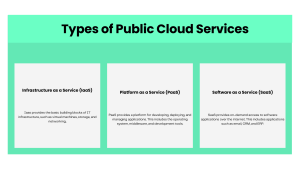
Software as a service (SaaS) Popular Public Cloud Providers
There are many public cloud providers available, but some of the most popular include:
- Amazon Web Services (AWS)
- Microsoft Azure
- Google Cloud Platform (GCP)
- Alibaba Cloud
- Tencent Cloud
How to Choose the Right Public Cloud Provider
There are many factors to consider when choosing a public cloud provider, such as your budget, your specific needs, and the security features offered. It is important to do your research and compare different providers before making a decision.
Conclusion
Public cloud technology can be a great way for businesses to save money, increase flexibility, and improve their IT infrastructure. If you are considering moving to the cloud, be sure to weigh the benefits and drawbacks carefully and choose a provider that is right for you.
Private cloud:
Private cloud technology offers an alternative to public cloud environments. Here’s a breakdown of its key aspects:
What is it?
Private cloud technology provides cloud services dedicated to a single organization. This means the underlying infrastructure, like servers, storage, and networking, is exclusively used by your organization and not shared with others. It can be hosted on-premises in your own data center, managed by a third-party provider in their facility, or hosted by a combination of both.
Benefits:
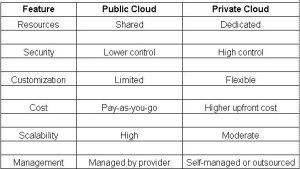
- Security and control: You have complete control over your data and security, unlike the cloud where shared resources might pose some risks.
- Customization: You can tailor the infrastructure and services to meet your specific needs and compliance requirements.
- Performance: Dedicated resources often lead to predictable and potentially faster performance compared to shared resources in public clouds.
- Flexibility: You can choose whether to manage the infrastructure yourself or outsource it to a managed service provider.
Drawbacks:
- Cost: Setting up and managing a private cloud can be more expensive than using a public cloud service.
- Complexity: It requires more technical expertise to manage compared to the public cloud’s ease of use.
- Scalability: Scaling resources up or down might be less flexible compared to the public cloud’s on-demand scalability.
Use cases:
- Organizations with strict data security and compliance requirements, like financial institutions or healthcare providers.
- Companies need high-performance computing for large-scale data analysis or scientific simulations.
- Businesses require granular control over their IT infrastructure and applications.
Comparison to Public Cloud:
Conclusion:
Private cloud technology offers a secure, customizable, and high-performance solution for certain organizations. However, it comes with higher costs and complexity compared to public clouds. Carefully consider your specific needs, budget, and technical expertise before choosing the right cloud technology for your organization.
Hybrid cloud:
Hybrid cloud technology blends the worlds of public and private clouds, creating a flexible and versatile IT environment. Here’s a breakdown of its key aspects:
Concept:
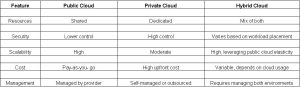
A hybrid cloud combines resources and services from both public and private clouds, allowing you to leverage the strengths of each model. You can deploy sensitive data and mission-critical applications on your secure private cloud while using the public cloud for less critical tasks, scaling, and cost-effectiveness.
Benefits:
-
- Flexibility: Allocate workloads to the most suitable environment based on security, cost, and performance needs.
- Scalability: The public cloud provides on-demand resources for sudden spikes or unpredictable workloads, while the private cloud offers stable capacity for core operations.
- Cost-efficiency: Optimize costs by using the public cloud for non-critical tasks and keeping sensitive data in the private cloud.
- Disaster recovery: Replicate essential data and applications to the public cloud for disaster recovery and redundancy.
Challenges:
-
- Complexity: Managing two environments requires expertise and integration tools to ensure seamless data flow and application management.
- Security: Maintaining consistent security policies across both environments is crucial to avoid vulnerabilities.
- Network latency: Transferring data between clouds can introduce latency, impacting performance for certain applications.
Use cases:
-
- Companies need to comply with strict data regulations but require scalability for non-regulated workloads.
- Organizations with fluctuating resource demands benefit from elastic public cloud resources for peak periods.
- Businesses seeking disaster recovery solutions with geographically dispersed infrastructure across private and public clouds.
Comparison to other models:
Conclusion:
Hybrid cloud technology offers a powerful and adaptable solution for many organizations. Carefully consider your specific needs, resources, and technical expertise before implementing a hybrid cloud model. Consult with cloud experts to design and manage your hybrid infrastructure effectively.
Service models define what type of cloud services are offered. Here are the three main service models:
-
- Infrastructure as a Service (IaaS): IaaS provides the basic building blocks of cloud computing, such as virtual machines, storage, and networking. Users have full control over these resources and can install any software they need.
-
- Platform as a Service (PaaS): PaaS provides a platform for developing, deploying, and managing applications. Users don’t have to worry about managing the underlying infrastructure, but they have less control over the environment.
-
- Software as a Service (SaaS): SaaS provides on-demand access to software applications over the Internet. Users don’t have to install or manage the software, but they have the least amount of control over the environment.
In addition to these main categories, several other cloud technologies are important to consider, such as:
-
- Server less computing: Server less computing allows you to run code without having to manage any servers. You simply pay for the resources you use.
- Cloud storage: Cloud storage allows you to store your data in the cloud, where it is accessible from anywhere.
- Cloud security: Cloud security is a critical aspect of cloud computing, as you need to ensure that your data is protected.
- Cloud networking: Cloud networking allows you to connect your cloud resources and the internet.
The best way to choose the right cloud technologies for your needs is to consider your specific requirements and budget.